A contact-center integration can use the same underlying architecture and still look very different at the agent desktop.
That is especially true in banking and healthcare. Both industries need fast access to authoritative records. Both handle sensitive information. Both need identity, access and audit controls to travel with the interaction. But the data an agent needs, the actions they take and the consequences of exposing the wrong information are not interchangeable.
CoreConnect is built around a common foundation for both environments: verify first, retrieve live context from the system of record, disclose only what the interaction requires, and deliver it inside the contact-center workspace rather than a separate bolt-on window. What changes by industry is the context itself.
For a bank or credit union agent, the useful opening context is financial and service-oriented. Once the caller is verified, the agent may need to see the member identity, an account summary and balances, recent transaction history, and the holds, alerts or servicing flags that explain why a routine request may not be routine.
That context changes the first minute of the call. If a member is calling about a card, a transfer or a payment, the agent can begin from the account state instead of first asking the member to wait while the core is opened and searched. A servicing flag can surface before the agent promises an action that is not available. Recent transactions can give immediate context to a question about a charge. The system can also put common servicing actions — such as transferring funds, making a payment, resetting a PIN or ordering a card — closer to the conversation.
The important point is where the information comes from. CoreConnect is designed to connect the contact center to banking systems including Fiserv, Jack Henry and FIS, as well as Corelation for credit unions. The core remains the source of truth; CoreConnect brings the relevant live context into the agent experience.
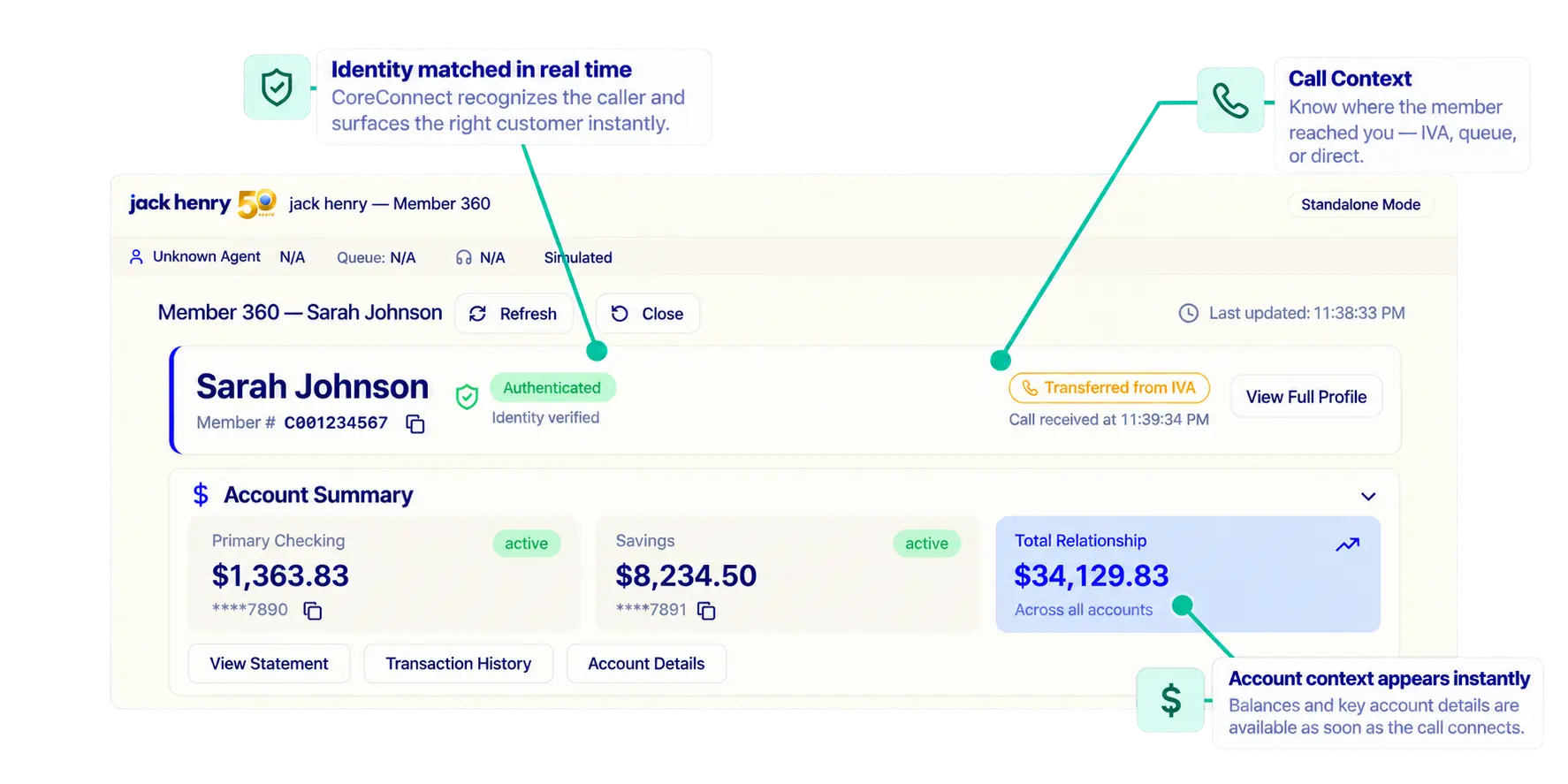
Speed cannot come at the cost of disclosure control. Recognizing a phone number is not the same as authenticating the account holder. A verification-first flow confirms identity before sensitive account information is shown, then applies progressive disclosure so the agent receives the information appropriate to the interaction.
The stakes behind that requirement have only grown. U.S. account takeover fraud losses reached nearly $16 billion in 2024, with reports up more than 36% year over year — a trend that isn't limited to digital channels. A verification step that feels like friction is, in practice, the control standing between a routine call and a fraud loss."
Auditability matters at the account level as well. Every data access should be traceable, and credentials should not be exposed in the browser. CoreConnect's architecture keeps API credentials server-side, logs access and runs on the institution's own infrastructure with no cloud component in the data path.
For a banking buyer, the useful evaluation question is therefore not simply "Can it screen-pop our core?" It is "Can it bring the right live core context into our contact center while preserving our verification, access and audit requirements?"
Healthcare starts from a different record model. The agent is not looking for an account balance or transaction hold; they are trying to understand who the patient is and what part of the care journey matters to the call.
On connect, that can mean a patient banner with MRN, date of birth, primary care provider and insurance payer. From there, the relevant context may include upcoming appointments and encounter history, active medications, allergies, lab results or vitals. Common actions are different too: schedule an appointment, refill a prescription, verify insurance or route the patient to the right clinical or administrative workflow.
CoreConnect supports Epic as a healthcare system of record, bringing relevant live patient context into the contact-center workflow.
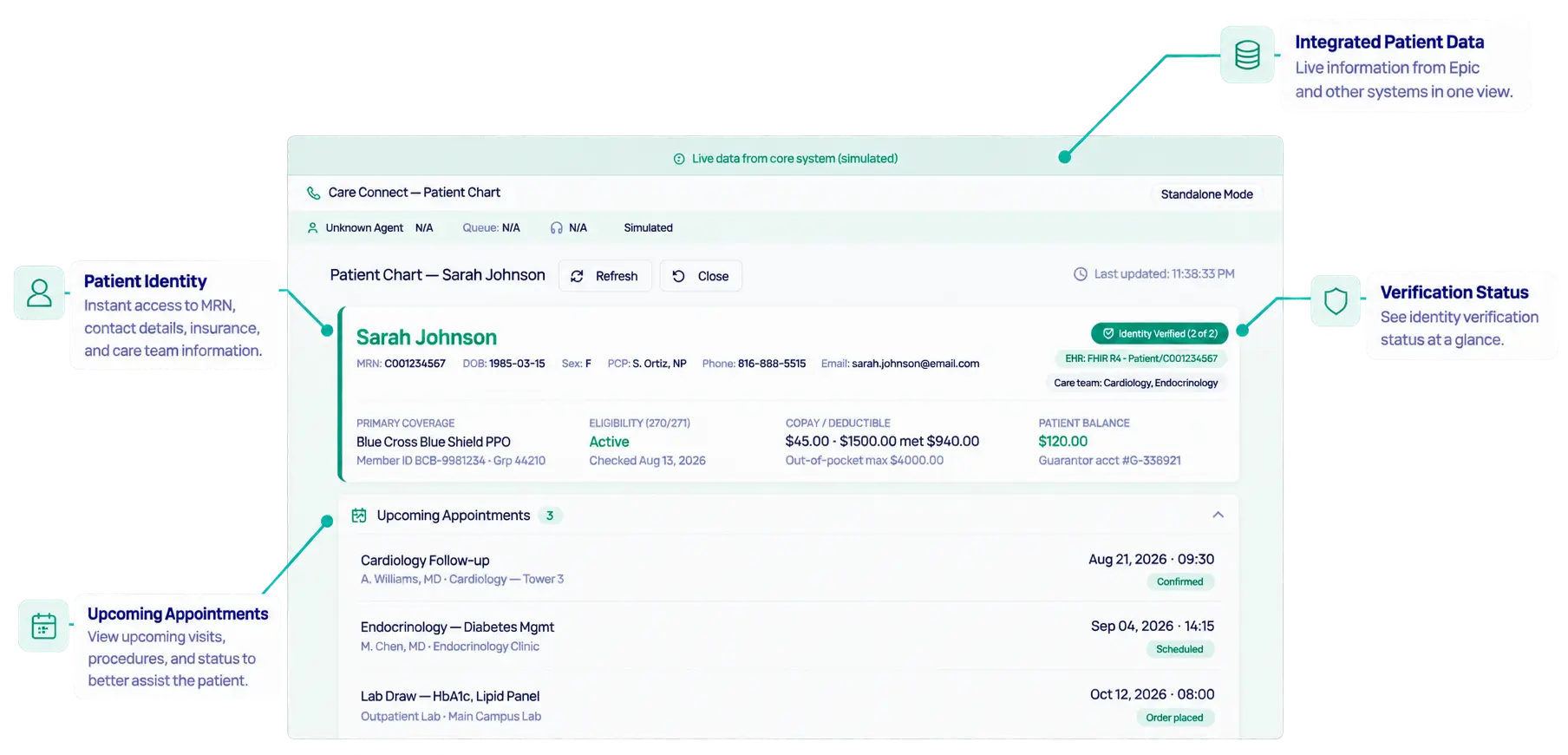
The sensitivity of clinical information changes the disclosure posture. A matching caller ID cannot be allowed to expose medications, allergies, lab results or appointment information before identity is confirmed. Verification has to occur first, with only the information required for the interaction made available afterward.
This isn't a theoretical risk. ECRI Institute's Patient Safety Organization analyzed more than 7,600 wrong-patient identification errors across 181 healthcare organizations and found that 9% resulted in patient harm, including two deaths — with 72% occurring during patient encounters, the exact moment a contact-center interaction hands context to clinical or administrative staff. Getting identity right before information moves isn't only a HIPAA requirement; it's a patient-safety one.
HIPAA-aligned handling also depends on more than what appears on screen. Data flow, role-based access, server-side credentials and audit-ready logging all matter because the integration is touching protected information while the patient is actively engaging with the organization.
For a healthcare buyer, the question is not simply "Can it connect to Epic?" It is "Can it bring the specific Epic context our access teams need into the contact-center workflow without creating a second, less-governed path to clinical data?"
The data models are different, but the design principles are the same.
First, the interaction should arrive with verified context rather than forcing the agent to start from a blank search. Second, the integration should be native to the workspace the agent already uses, not a second application with another login. Third, the system of record remains authoritative; the integration retrieves and presents what is needed rather than creating a competing copy of the data. Fourth, access should be progressively disclosed and fully auditable.
The compliance stakes for getting this wrong are comparable across both industries, even if the failure modes differ. Healthcare and financial services are, respectively, the first- and second-costliest industries for data breaches, averaging $6.64 million and $6.29 million per incident. That shared exposure is exactly why CoreConnect uses one architecture rather than two.
That common foundation is why this is not two unrelated products with a shared name. CoreConnect uses the same verification-first, native-integration approach across banking and healthcare, then adapts the record model, terminology, actions and controls to the institution.
In both verticals, the goal is the same: give the agent the context to start the real conversation sooner without weakening the controls regulated organizations depend on.
Start with your core and your highest-volume service journeys. Ask which Fiserv, Jack Henry, FIS or Corelation data elements should be available when a verified call connects. Identify the holds, alerts and servicing flags that most often force agents into a second search. Then map the quick actions that would remove the most navigation without changing the core as the system of record.
A useful discovery session should also validate your authentication flow, disclosure rules, audit requirements and call volume so the integration is sized to the way your institution actually operates.
Start with the Epic context your patient-access or service teams need most often. Define what belongs in the initial patient banner, what should remain behind progressive disclosure, and which workflows — appointments, insurance verification, refill requests or others — create the most avoidable navigation today.
Then validate how verification, access controls, logging and data-path requirements fit your organization's HIPAA and security posture. The goal is to surface the right data for the interaction, under the right controls.
CoreConnect is built to make that distinction practical: one verification-first integration model, configured for the very different realities of financial and healthcare service.


Condado has become part of One Primero — a consolidated operating brand bringing Condado's contact center expertise and Tricension's technology delivery capability together under one name. Same team, same relationships. New name.