Why Contact Center Agents Still Answer Blind in 2026
“Thanks for calling. Can I start with your full name?”
Then comes the familiar follow-up: “One moment while I pull up your account.”
Those lines sound ordinary because contact centers have trained themselves to accept them. But they reveal a strange design choice. The customer has already reached the right organization. The call has already passed through an IVR and routing logic. The institution already has a system of record full of the information the agent will need. Yet when the agent answers, the conversation often starts as if none of that context exists.
According to Zendesk's CX Trends 2026 report, 74% of consumers say they find it frustrating to repeat their story to different agents — and for many banking and healthcare callers, the first agent they reach is already a repeat performance of information the institution technically already has.
The agent has a voice, a phone number and a queue. The customer or patient has a history, an account or medical record, recent activity and a reason for calling. The gap between those two realities is where the first 15–45 seconds of many calls disappear.
The Hidden Cost of Slow Screen Pop: An Operational Expense, Not a CX Problem
It is easy to describe those seconds as a customer-experience problem: awkward silence, repeated questions, another moment of friction. That is true, but it understates the issue. At contact-center scale, lookup time is an operating expense.
Take a high-volume operation handling 10,000 calls in a day. Fifteen seconds per call adds up to more than 41 agent hours. Forty-five seconds adds up to 125 hours. That 15-to-45-second range isn't a figure we invented for this piece — industry coverage of screen pop deployments consistently cites the same window as the typical time a caller's record being available up front saves per call.
Not every second can be eliminated, and identity verification still matters. But when a meaningful share of that time is spent opening systems, searching for a record and reconstructing context the enterprise already has, the workflow is consuming capacity before the real service conversation has begun.
That pressure shows up in average handle time, queue depth and staffing models. It also compounds across the rest of the interaction. An agent who starts without context is more likely to ask the customer to repeat information, place the caller on hold while checking another application, or lose time moving between systems. The “swivel-chair” workflow becomes normal: one interaction, four to seven applications, and the agent acting as the integration layer between them.
Why Legacy Screen Pop Integrations Never Actually Fixed This
The underlying technology is not new. Enterprises have been able to query systems of record, match interaction data and trigger screen pops for years. The problem is that many implementations treated screen pop as an accessory to the contact center rather than part of the interaction architecture.
A common result is another window. Another login. Another browser tab. Another integration for IT to maintain. The screen pop may show a phone number, launch a search or open a generic record, but the agent still has to finish the job: decide where to look, verify the person, reconcile what appears on screen and navigate back to the conversation.
That approach can make search faster without changing the basic workflow. The agent still goes to the applications to assemble context. The customer still waits while that assembly happens.
This is why “we need faster search” is the wrong diagnosis. Search is only necessary because the interaction and the system of record have been designed as separate experiences. The more durable fix is to connect them so that the relevant, verified context can arrive with the interaction itself.
Verification-First Screen Pop: What Banking and Healthcare Contact Centers Require
Banking and healthcare make this architectural problem harder—and more important. A phone-number match is not enough to expose an account balance, transaction history, medication list or appointment record. Identity has to be confirmed before sensitive information is disclosed, and access has to be governed and auditable.
That changes what “screen pop” should mean. It is not simply recognizing an incoming number and opening a record. A verification-first design uses the interaction flow itself to establish identity, then retrieves only the information appropriate to the interaction. Progressive disclosure matters. Auditability matters. Where credentials live matters. The data path matters.
When those controls are built into the architecture, speed and security stop being opposing goals. The contact center can remove avoidable search work without asking agents to bypass the verification process that protects the customer, patient and institution.
Why Agent Context Should Arrive Before the Call Connects
The best contact-center experiences do not begin when the agent finally finds the right record. They begin when the interaction enters the system.
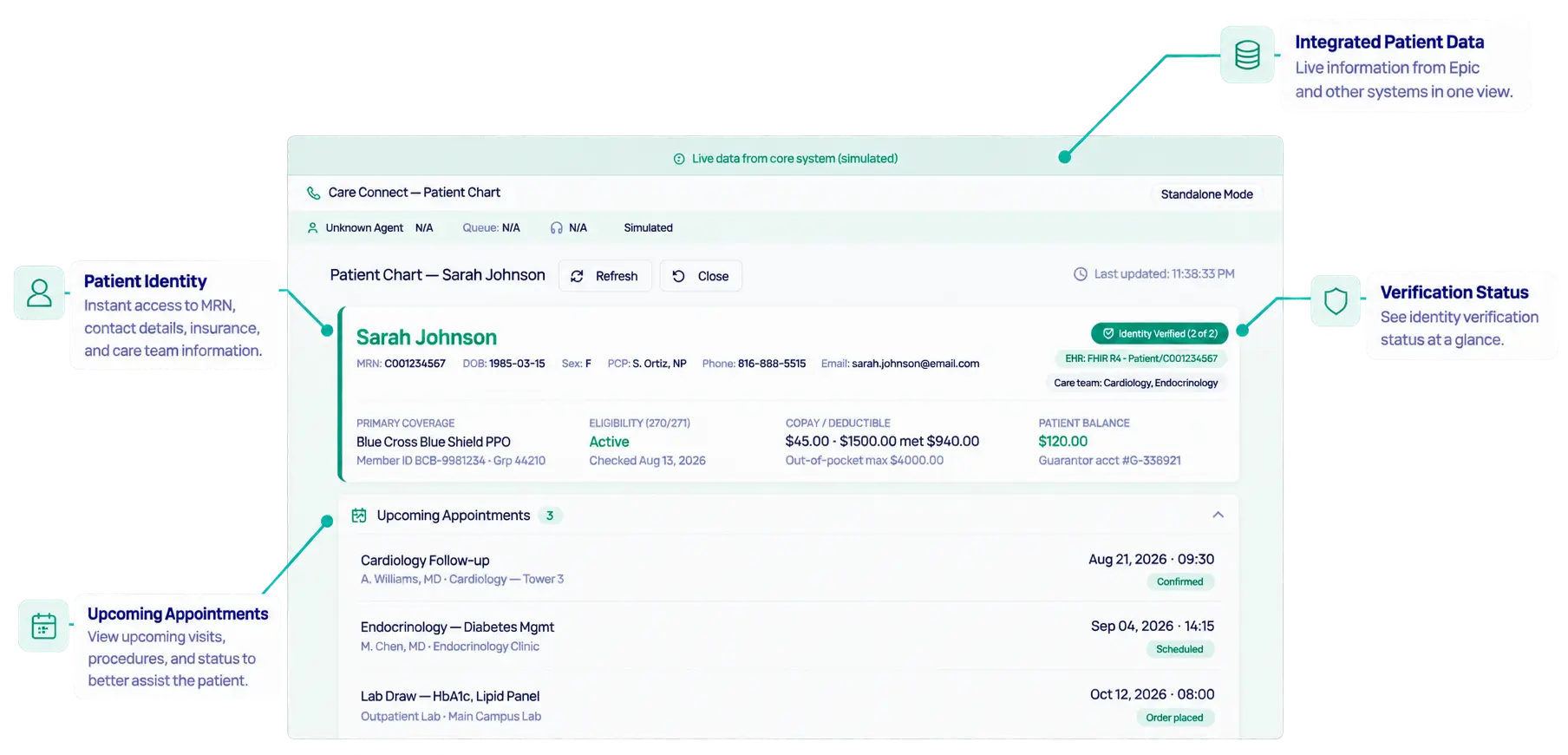
By the time a verified caller reaches an agent, the enterprise already has an opportunity to know who is calling, retrieve the relevant account or patient context and present it in the workspace where the agent is already working. That changes the opening of the call from “Who are you, and where do I find you?” to “I have the right context; how can I help?”
It is a small change in what the customer hears, but a significant change in what the architecture is doing.
CoreConnect: Verification-First Screen Pop for Banking and Healthcare Contact Centers
CoreConnect is Condado’s implementation of that model. It is a verification-first integration layer for banking and healthcare contact centers that connects the interaction to the system of record and surfaces the relevant account or patient context as the call connects. It runs natively inside NiCE CXAgent and Zoom Workplace, connects to systems including Fiserv, Jack Henry, FIS, Corelation and Epic, and is designed to run on the institution’s own infrastructure with no cloud component in the data path.
The point is not to give the agent one more application. It is to remove the need for one more search.
Secure SD-WAN: Make Branch Connectivity a Security Decision
As branches connect directly to cloud applications, every WAN decision also becomes a security decision. Learn what Secure SD-WAN changes and how to plan it.
Condado has become part of One Primero — a consolidated operating brand bringing Condado's contact center expertise and Tricension's technology delivery capability together under one name. Same team, same relationships. New name.