Designing the Contact Center Around Context, Not Applications
Enterprise contact centers have never had more capable technology. CCaaS platforms route and orchestrate interactions across channels. CRMs hold richer customer histories. Banking cores and EHRs remain authoritative systems of record. AI can summarize, recommend and automate. Yet in many operations, the agent is still the one responsible for stitching all of it together in real time.
The call arrives. The agent decides where to look. A CRM tab opens. Then the core system. Then a knowledge base. Maybe an identity tool, a payment screen or an appointment system. The agent searches, compares and reconciles what each application says, then returns attention to the customer.
Harvard Business Review's study of 137 workers across three Fortune 500 companies found that the average digital worker toggles between applications and websites nearly 1,200 times a day — costing almost four hours a week, roughly 9% of total work time, just reorienting after each switch. A contact center agent juggling a CCaaS platform, a CRM, a core system and a knowledge base mid-call is a concentrated, high-stakes version of exactly that pattern.
Each platform may be working exactly as designed. The workflow between them is what is broken.
The Application-Centric Contact Center Model: Why More Platforms Created More Agent Work
Most enterprise technology estates were built application by application. A platform was selected for telephony and routing. Another for customer records. Another for transactions or clinical data. Additional tools were added for knowledge, quality, workforce management, payments, authentication and AI.
That modularity is not inherently a problem. Specialized systems are often the right choice. The problem appears when the agent desktop mirrors the application map.
In an application-centric operating model, the agent becomes the navigation layer. The interaction tells the agent there is work to do, but the agent is expected to determine which systems contain the relevant facts, retrieve those facts, decide which version is current and carry the information mentally from one interface to another.
That is more than "too many tabs." It is an architectural dependency on human integration — the same toggling cost HBR documented across knowledge work generally, except here it happens live, on a call, with a customer or patient waiting on the other end. Every new platform can increase capability while simultaneously increasing the amount of context the agent has to assemble.
Context-Centric Design: Making the Interaction the Organizing Event
A context-centric design reverses the flow.
Instead of sending the agent to applications to find context, the interaction becomes the organizing event that gathers the context required for the work. Identity, history, status, flags and relevant actions are assembled from the systems that own them and delivered into the workspace where the conversation is already happening.
The systems of record do not disappear. The CCaaS platform does not need to become the database. The CRM does not need to absorb every function. The change is in orchestration: applications remain authoritative for their domains, while the interaction layer brings forward what is needed now.
That distinction matters because "single pane of glass" projects often fail when they try to recreate every enterprise application inside one giant interface. Context-centric architecture is narrower and more practical. It asks a different question: what does this agent need for this interaction, at this moment, and what is the safest way to make it available?
Why Context-Centric CX Reduces Operational Friction, Not Just Clicks
The benefit is not convenience. It is less operational translation.
When agents stop acting as the bridge between systems, several forms of friction decline at the same time.
There are fewer credentials and interfaces to learn. Training can focus more on customer needs, judgment and resolution instead of memorizing navigation paths. Agents are less likely to lose the thread of a conversation while switching windows. Transfers and escalations can carry more useful context forward. Supervisors have a clearer workflow to coach because the process is designed rather than improvised at the desktop.
The customer feels the same change from the other side. Fewer repeated questions. Less time on hold while someone "checks one more system." A greater chance that the first person who answers can understand the situation quickly enough to resolve it.
That is why connected CX is an operating-model issue, not a user-interface preference. The goal is not to make the desktop prettier. It is to reduce the amount of manual translation required between an interaction and the enterprise systems that can resolve it.
Verification-First Context: What Banking and Healthcare Contact Centers Require
In banking and healthcare, bringing context forward cannot mean exposing more information simply because it is technically available.
A phone number is a useful signal, not proof of identity. A customer record, account balance, medication list or appointment history should not appear until the required verification conditions have been met. The architecture also needs to control what is disclosed, where credentials live, and how access is logged.
The stakes behind that requirement are concrete. In IBM's Cost of a Data Breach Report 2026, healthcare data breaches averaged $6.64 million — the costliest of any industry for the 13th consecutive year — with financial services close behind at $6.29 million, 26% above the global average. Governance isn't a compliance formality layered on top of context-centric design; it's what determines whether bringing context forward is an asset or a liability.
That makes verification, progressive disclosure and auditability part of the context model itself. They cannot be added after the integration is built. The same orchestration that decides what information to retrieve also needs to enforce when it can be shown and leave a complete record of access.
For regulated enterprises, this is the difference between a convenient integration and a dependable one.
Why Contact Center AI Depends on a Structured Context Layer
This architectural shift also changes the ceiling for AI.
Agent-assist tools can summarize a transcript or suggest a response with relatively little enterprise integration. But the most valuable use cases depend on reliable business context. Is this the verified account holder? What product do they have? Is there a servicing flag? What was the last transaction? Does the patient have an upcoming appointment? Which actions are allowed in this workflow?
If that information is scattered across applications and has to be assembled manually by the agent, AI is working with the same handicap. It can sound intelligent while remaining operationally shallow. This isn't a hypothetical risk: Gartner predicts that through 2026, organizations will abandon 60% of AI projects that aren't supported by AI-ready data — fragmented, unstructured context isn't just an agent problem, it's the same failure mode that derails contact center AI initiatives before they scale.
A structured, verified context layer gives both human agents and AI systems a better starting point. Agent assist can make recommendations against real account or patient state. Automation can act within clearer permissions. Agentic workflows can orchestrate tasks across systems with stronger governance because identity, data access and interaction state are already part of the architecture.
The AI does not replace the systems of record. It becomes more useful because those systems can provide governed context at the moment of action.
CoreConnect: A Context-Centric Architecture for Banking and Healthcare Contact Centers
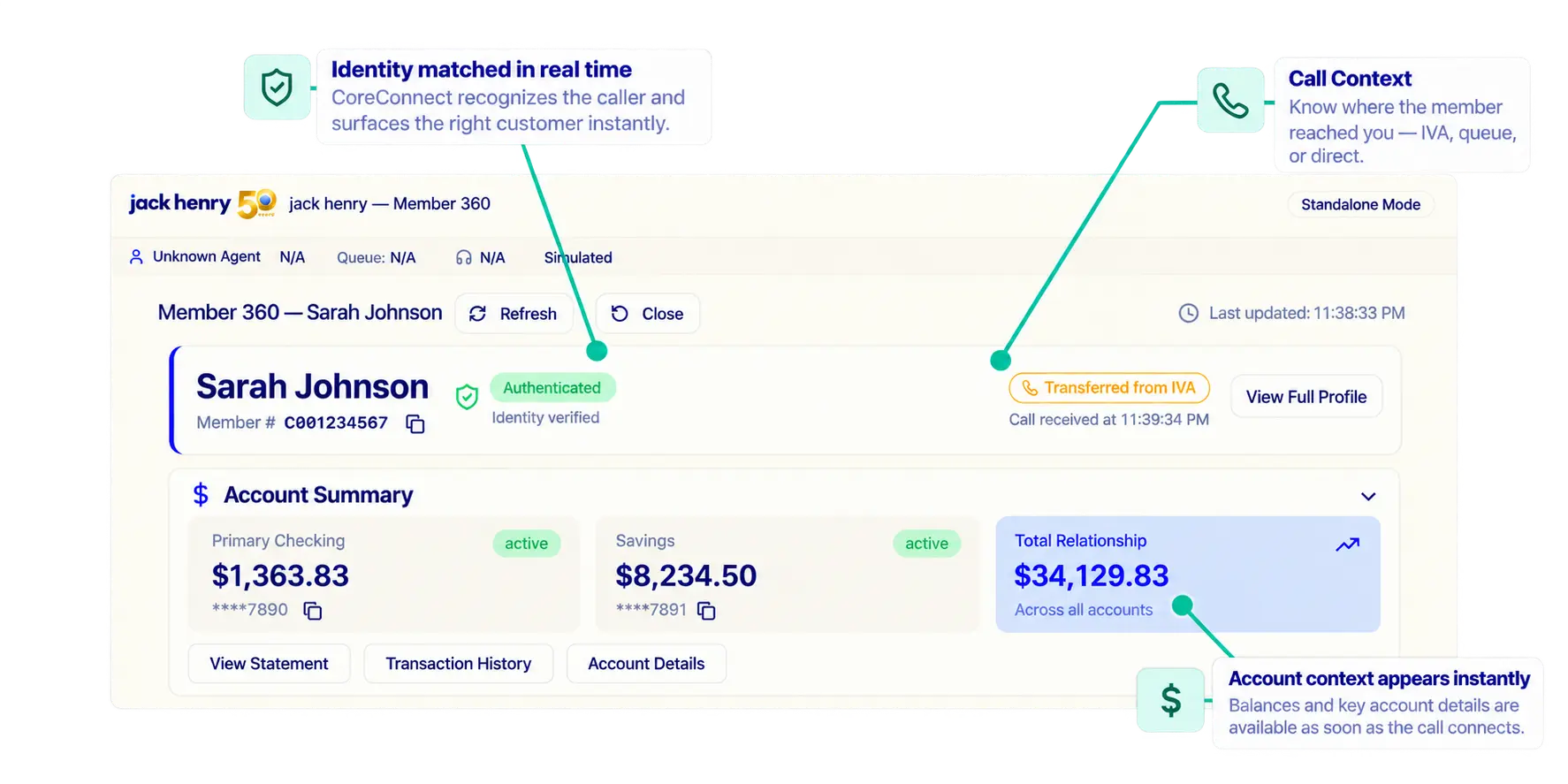
CoreConnect applies this model to a specific, high-friction moment: the start of a banking or healthcare call. Rather than functioning as another agent application, it connects the contact-center interaction to the core system or EHR and brings the relevant, verified context into the existing agent workspace.
In supported environments, CoreConnect runs natively inside NiCE CXAgent and Zoom Workplace and connects to systems including Fiserv, Jack Henry,FIS, Corelation and Epic. Its verification-first architecture is designed to confirm identity before sensitive information is disclosed, progressively expose only what the interaction requires and maintain an audit trail of data access.
That is the broader design principle Condado brings to connected CX architecture: keep the systems that are good at what they do, but stop making the agent carry the integration burden between them.
The next efficiency gain in enterprise CX is unlikely to come from adding one more application to the desktop. It will come from making the interaction itself the place where the right context, controls and actions come together.
Stop designing the agent journey around applications. Design the technology around the interaction.
Why Contact Center Agents Still Answer Blind in 2026
See why 15–45 seconds of blind lookup per call still costs banking and healthcare contact centers agent hours in 2026 — and what a verification-first fix looks like.
Claudeforce Explained: Salesforce, Claude & Enterprise AI
Claudeforce connects Salesforce data, workflows, permissions, and business logic with Anthropic’s Claude. Here’s what has shipped, what remains early, and what enterprises should evaluate.
Condado has become part of One Primero — a consolidated operating brand bringing Condado's contact center expertise and Tricension's technology delivery capability together under one name. Same team, same relationships. New name.